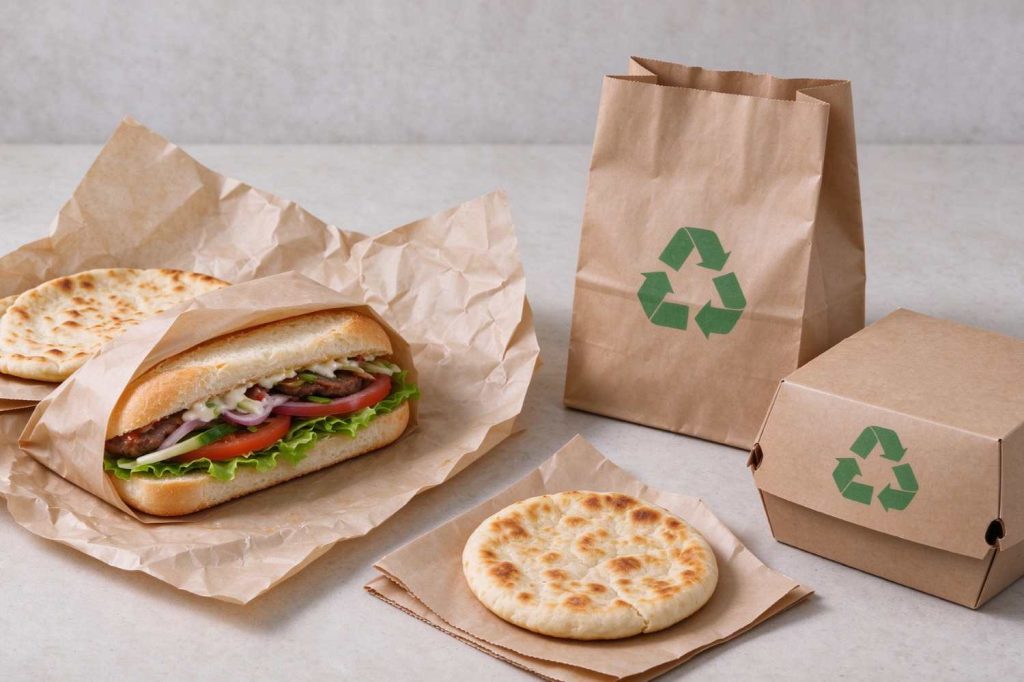
A heat-sealable paper grade must do more than look suitable for a food package. It must form a dependable seal on the customer’s equipment, protect the product as required, and meet the applicable food-contact requirements for the intended market and use. Problems often arise when a buyer specifies only the paper’s basis weight or general coating type and leaves the actual sealing conditions until the production trial.
The most reliable way to source heat-sealable paper is to define the package, the sealing process and the required documentation before placing a bulk order. This guide explains the main points converters and packaging buyers should confirm with their paper supplier.
Key takeaways
- Not every coated paper is designed to form a reliable heat seal. Confirm that the coating is specifically formulated for the intended sealing process.
- Ask for the recommended sealing temperature range, pressure and dwell time—not just a single temperature value.
- Share the product, package construction and machine details with the supplier before selecting a grade.
- Validate the material on the actual production line at normal operating speed and with the intended product.
- Request food-contact documentation that applies to the specific paper grade, coating, food type and conditions of use.
1. Understand what makes paper heat-sealable
Heat-sealable paper is paper or paper-based packaging material with a surface layer designed to soften, activate or otherwise bond under defined heat-sealing conditions. When the correct coated surfaces are brought together with suitable temperature, pressure and contact time, the material can form a seal.
The key point is that heat-sealing performance depends on the complete material construction. The base paper, coating formulation, coating weight, surface treatment and sealing conditions all matter. A paper described simply as “coated” should not automatically be assumed to be heat-sealable.
Materials that should not be assumed to be heat-sealable
- Plain uncoated paper: without a suitable heat-activated layer, it generally will not form a conventional heat seal.
- Standard greaseproof paper or parchment: grease resistance alone does not establish heat-sealing capability.
- General-purpose wax-coated paper: wax may soften with heat, but that does not guarantee a strong, consistent or durable package seal.
- General-purpose PE-coated paper: some PE-coated constructions can be heat-sealed, but performance depends on the polymer grade, coating design, surface and process conditions. Confirm that the specific grade is designed and tested for the intended application.
Heat-sealable paper and heat-sealable BOPP film are not interchangeable
Heat-sealable BOPP film and heat-sealable paper can serve different packaging objectives. BOPP is a plastic film commonly selected for its clarity, moisture barrier and film-converting characteristics. Paper-based structures may be chosen for their paper appearance, stiffness, print presentation or compatibility with a paper-focused packaging strategy. Their heat response, sealing windows and barrier performance are not identical. Do not transfer machine settings from one material to the other without testing.
2. Confirm the coating and surface properties
The coating is central to seal formation, but the right formulation depends on the food product and package design. A coating selected for one purpose—such as grease resistance, moisture resistance or release—may not provide the sealing performance needed for another.
| Construction / coating family | What to verify before specifying it |
| Heat-sealable polymer coating (for example, a suitable PE-based formulation) | Confirm that the exact formulation is designed for heat sealing, and obtain its recommended sealing range and performance data. |
| Grease-resistant coating | Confirm whether it is also heat-sealable. Grease resistance and heat-seal performance are separate properties. |
| Wax-based coating | Do not assume that softening or tack under heat will produce a durable package seal. Require application-specific test results. |
| Silicone or release coating | Typically selected for release characteristics. Do not treat a silicone release surface as a heat-seal layer unless the supplier provides evidence for that specific construction. |
Coating information to request
- Coating type and formulation family: identify the functional coating and whether it is designed for heat sealing.
- Coating weight: request the nominal value and tolerance for the offered grade. There is no single coating-weight range that applies to every heat-sealable paper.
- Activation and sealing range: ask for the temperature range in which the material is expected to achieve acceptable seal performance under stated test conditions.
- Seal strength and test method: request relevant data, including the test method and conditions used to generate the result.
- Surface orientation: confirm which side or sides are coated and which surfaces must contact each other during sealing.
Important: A supplier’s laboratory data is a starting point, not a guarantee of performance on every packaging line. Sealing results depend on the material construction and the customer’s equipment and process settings.
3. Specify basis weight and paper properties
Basis weight, usually expressed in grams per square metre (GSM), affects material consumption, stiffness and handling. Paper thickness, coating construction, moisture condition and fibre characteristics can also influence converting behaviour and package performance.
When requesting a quotation, state the target basis weight and acceptable tolerance. If thickness, stiffness, opacity, printability or a particular barrier property is important, list it as a separate requirement rather than assuming it will be determined by GSM alone.
A heavier paper does not automatically create a stronger heat seal. Seal performance is determined by the sealable layer and the combined effects of temperature, pressure, dwell time, material surface and package design.
4. Check compatibility with the sealing equipment
A material that performs well in a laboratory test may behave differently on a production line. Heat transfer, jaw geometry, line speed, pressure distribution and the package contents all influence the result.
Equipment information to share with your supplier
- Sealer or form-fill-seal (FFS) machine manufacturer and model
- Sealing method and jaw configuration
- Jaw material, jaw width and sealing-surface condition
- Normal production speed and expected operating range
- Available temperature and pressure settings
- Package dimensions, seal geometry and whether one or both surfaces are coated
The three main sealing variables
| Variable | Why it matters |
| Temperature | The sealing surface must reach a suitable temperature for the specific coating construction. Excessive heat can also damage or distort the material. |
| Pressure | Pressure brings the intended surfaces into contact. Uneven pressure can create weak areas or inconsistent seals. |
| Dwell time | The material needs sufficient contact time for heat transfer and bond formation. Changes in line speed may require process adjustments. |
These variables interact. A change in line speed, paper grade, coating or jaw setup may require the sealing conditions to be re-optimised. Ask the supplier for a recommended starting range and confirm it through controlled trials.
5. Match the paper to the product and seal design
The contents and package geometry determine the demands placed on the material. Moisture, oil or fat, product temperature, filling conditions and handling can all affect package performance. The supplier should understand the actual application before recommending a grade.
| Application factor | Information to provide |
| Product characteristics | Dry, moist, oily or fatty product; product temperature at packing; and any special storage conditions. |
| Package format | Pouch, sachet, wrap, bag or other format, including dimensions and material layers. |
| Seal geometry | Fin seal, lap seal, end seal or another configuration; provide a drawing or sample where possible. |
| Performance target | Required seal strength, leak resistance, opening behaviour and expected shelf-life conditions. |
Avoid assuming that one seal type is always less demanding than another. The actual stress on a seal depends on package geometry, material orientation, product weight, filling method and downstream handling. Ask the supplier to assess the complete package rather than choosing a coating based only on a generic seal-type label.
6. Conduct an on-machine trial before bulk production
Laboratory seal-strength results cannot reproduce every production condition. Before committing to a large order, test the proposed grade on the intended machine and, where practical, with the actual product.
Suggested trial protocol
- Use the intended paper grade and confirm roll orientation and coated-side position before threading the machine.
- Set up the line using the supplier’s recommended starting parameters, then optimise temperature, pressure and dwell time within the equipment’s safe operating limits.
- Test at representative production speeds rather than relying only on slow manual or laboratory trials.
- Run the package with the actual product or a representative load, because the contents can affect heat transfer and seal formation.
- Inspect all relevant seals and evaluate seal strength, leakage or integrity, appearance, wrinkles, contamination and ease of opening, as applicable.
- Record the material batch, machine settings, line speed and test results so that the approved conditions can be repeated.
Samples, trial rolls and minimum order quantities
Ask whether the supplier can provide sheet samples for preliminary evaluation and a trial roll for machine testing. Sample format and availability vary by material and supplier. Minimum order quantities also depend on the grade, coating setup, production schedule and required width; confirm the actual MOQ when requesting a quotation.
7. Confirm food-contact compliance and documentation
Food-contact suitability must be assessed for the specific material construction and intended conditions of use. The base paper alone does not determine whether a finished package is suitable for food contact. Coatings, adhesives, inks and other layers may also need to be considered.
For the United States, FDA regulations relevant to paper and paperboard components may include provisions in 21 CFR Part 176, including section 176.170 where applicable to the intended food types and conditions of use. For Germany, BfR Recommendation XXXVI is a relevant guidance document for paper and board intended for food contact. It should not be described as a single harmonised EU-wide certification. Other markets may have different legal requirements.
PFAS requirements are also evolving and can vary by jurisdiction, product category and customer specification. If PFAS-related claims are required, define exactly what is being claimed—for example, no intentionally added PFAS—and request supporting declarations or test reports with the relevant methods and reporting limits. Avoid treating “PFAS-free” as a universal certification unless the scope and evidence are clearly defined.
Documents to request
- A product-specific technical data sheet (TDS)
- A food-contact compliance statement or Declaration of Compliance/Conformity, as applicable to the destination market and intended use
- Relevant migration or other supporting test reports, where required
- Statements covering inks, adhesives and additional layers where these are part of the supplied construction
- PFAS-related declaration or test evidence when required by the applicable rules or customer specification
- Batch or quality inspection records, where available and agreed
Always check that documents identify the correct grade and construction and cover the intended food type, contact conditions and market. A generic statement that a material is “food grade” is not a substitute for application-specific compliance evidence.
8. Buyer’s checklist before placing an order
- Food product and intended packaging application are clearly described.
- Paper basis weight, tolerance and any thickness requirements are stated.
- The heat-seal coating and coated-side orientation are confirmed.
- Recommended sealing temperature range, pressure and dwell time are documented.
- Required seal performance and trial acceptance criteria are agreed.
- Applicable food-contact and PFAS-related documentation has been reviewed.
- Roll or sheet format, width, winding details, quantity, MOQ and delivery requirements are confirmed.
Frequently asked questions
Why does plain paper not form a reliable heat seal?
Plain paper generally does not contain a heat-activated bonding layer. A suitable heat-sealable construction is required for conventional heat sealing.
Can PE-coated paper be heat-sealed?
Some PE-coated paper constructions are designed for heat sealing, while others are not. Confirm the exact formulation, sealing range and test data for the grade being purchased.
Can I use the same settings for paper and BOPP film?
Not without validation. Paper-based materials and BOPP film have different heat-transfer and sealing characteristics. Optimise the settings for the specific paper grade and machine.
What information should I send when requesting a quotation?
Provide the product type, package format, target GSM, required width, machine and jaw details, line speed, seal design, intended market and any food-contact documentation requirements.
What food-contact documents should I request?
Request product-specific compliance documentation for the destination market and intended conditions of use, together with relevant supporting test reports and statements for coatings, inks or adhesives as applicable.
Discuss your heat-sealable paper requirements with Sure Paper Pak
Choosing a suitable heat-sealable paper grade starts with understanding your product, package construction and production equipment. Share your target basis weight, roll dimensions, sealing method and intended application with the Sure Paper Pak team so the material specification and trial requirements can be reviewed before bulk production.
Contact Sure Paper Pak to discuss your food packaging paper requirements and request product information or a quotation.