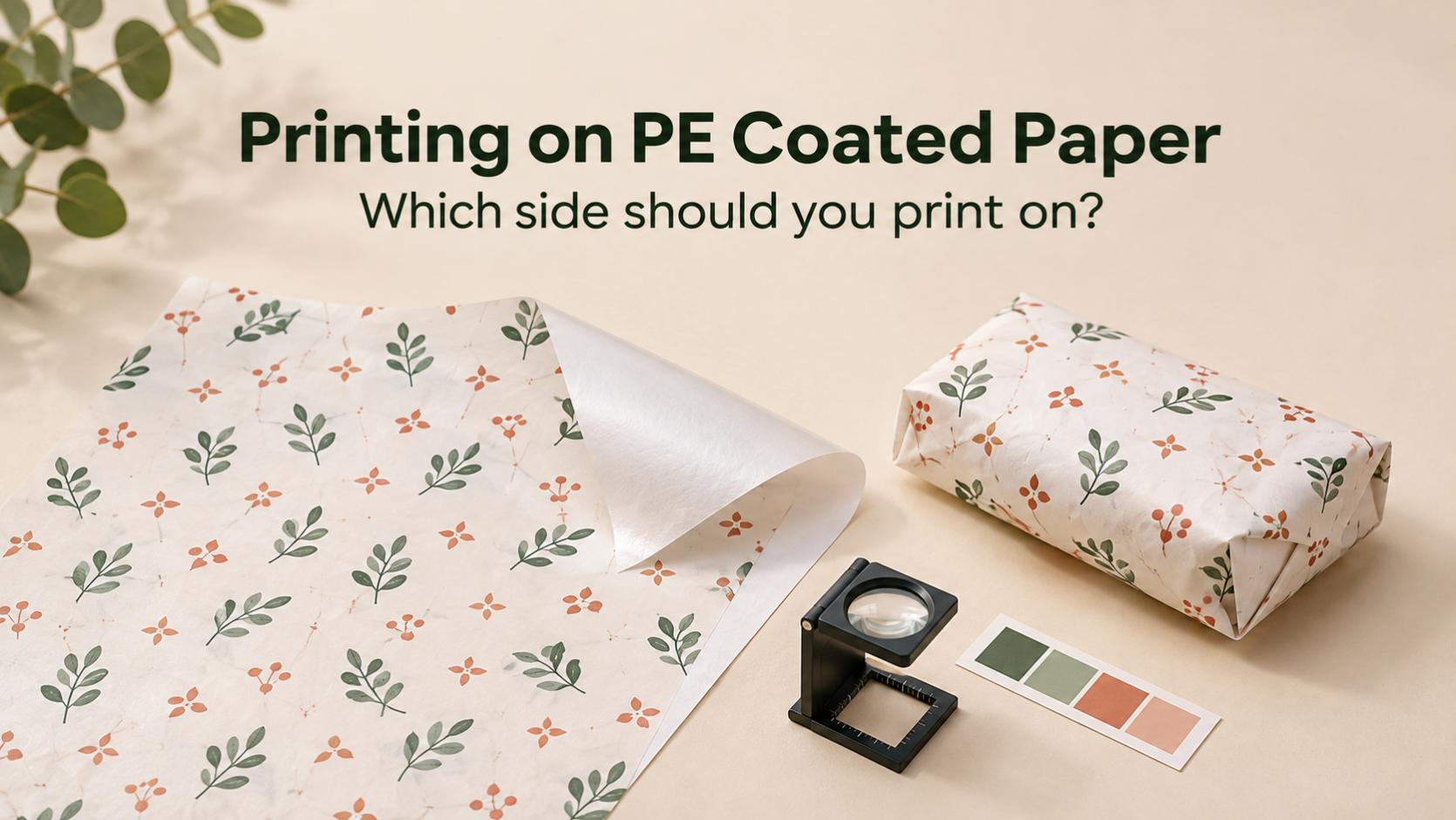
For single-side PE coated wrapping paper, the uncoated paper face is usually the first choice for printing, with the PE face used toward the food where appropriate. Before choosing a printing surface, confirm how the finished wrap will be used. The outside print face, food-contact face and any heat-seal areas should be clearly identified.
Printing on the PE face is also possible, but requires a suitable ink system, appropriate surface preparation and trials on the actual material. This guide explains how to identify each face and what to check before approving bulk production.
Key Takeaways
- Confirm the coating side and intended food-contact side before printing.
- Use supplier identification and a confirmed sample; gloss alone does not identify PE.
- Agree surface treatment requirements with the ink supplier and verify the PE surface before printing.
- Validate ink adhesion, drying or curing, rub resistance and blocking under agreed test conditions.
- Use actual stock for performance approval and a machine trial for production settings.
How to Identify the Coated Side of PE Wrapping Paper
PE coated wrapping paper combines a paper base with a polyethylene layer on one or both faces. The coating provides a moisture and grease barrier and may provide a heat-sealing surface, depending on the grade and process.
Single-Side vs Double-Side PE Coating
| Feature | Single-side PE coating | Double-side PE coating |
| Structure | One paper face and one PE face | PE on both faces |
| Printing choice | Paper face is usually the starting point | The selected PE face must be suitable for the ink system |
| Checks before use | Identify paper, PE and food-contact faces | Confirm treatment on each intended print face and identify the food-contact face |
Three Ways to Check the Sides
Start with the supplier’s coating-side identification, reel labels and an approved reference sample. Record the intended print face and winding direction when ordering reels.
Appearance and touch are supporting clues only. MG paper can have a smooth, glossy face without PE, while PE finishes vary. A water drop may help compare wetting and absorption, but sizing and other surface treatments can affect the result. Do not use either check as the sole proof of coating orientation.
Which Side Should You Print On
Uncoated Paper Side
The paper face is usually easier to print than untreated PE, but print quality still depends on the paper finish, absorbency, surface cleanliness and ink system. Confirm ink laydown, fine text and solid areas on the selected grade rather than assuming every uncoated face behaves the same.
Coated PE Side
Printing on PE requires an ink system suited to that surface. Corona treatment is commonly used to improve wetting; whether additional treatment is needed depends on the supplied material and its condition at printing. Gloss and color appearance depend on the coating finish, ink and printing process, so a PE face does not automatically produce a higher-gloss print.
Keep the Food-Contact Face in View
For conventional food wraps, plan the print on the non-food-contact surface. If ink will directly touch food, use a system specifically suitable for that application and verify the finished packaging for the intended food, contact time, temperature and destination market.
External printing also needs assessment: ink components may transfer through the structure or from the printed face to the food-contact face during stacking or winding, known as set-off. A PE layer should not be assumed to prevent all migration. Ask the ink supplier for relevant suitability information and assess the complete printed construction. [1]
Critical Pre-Production Checks for PE Coated Paper
1 Surface Treatment and Wetting
For PE-side printing, confirm the required treatment level with the ink supplier and printer. A single minimum dyne value is not suitable for every ink formulation or process. Surface treatment can decline during storage, so check the material shortly before printing rather than relying only on its original specification. [2]
Use a suitable dyne test on a separate PE sample according to the test product’s instructions. Treat the result as a wetting indicator, not proof of ink adhesion. Keep tested pieces out of finished food packaging.
| Check | What to confirm |
| Treatment requirement | Target agreed for the actual PE grade, ink and printing process |
| Condition before printing | Correct face, current wetting result and a clean surface |
| Print performance | Ink wetting, adhesion and drying or curing verified by trial |
2 Ink Compatibility and Adhesion
Confirm that the ink is suitable for the intended paper or PE face and the food-packaging application. Water-based, solvent-based and UV systems have different drying or curing requirements; the ink category alone does not establish suitability.
Use a tape adhesion test agreed with the printer, ink supplier and customer. Record the tape, sample conditioning, drying or curing interval, application procedure and removal method. Compare ink removal against an agreed acceptance limit and note whether failure involves ink, coating or paper fibers.
If ASTM D3359 is specified, confirm its suitability and procedure before testing. Method B includes cross-cutting, and the standard primarily addresses coatings on metallic substrates. A simple uncut tape pull is not Method B; acceptance criteria for the paper–PE structure should be agreed for the intended application. [3]
Add a rub test suitable for the finished wrap, with defined load, cycles and acceptance criteria. Include folding and handling checks; add wet or grease exposure where relevant to the intended use.
3 Drying and Blocking Prevention
Blocking occurs when contacting surfaces stick together in a stack or reel. Investigate incomplete drying or curing, residual heat, pressure and material compatibility. Excessive heat can affect PE, but reducing heat without checking drying may create another problem.
Verify dryer settings, airflow, line speed and cooling for the selected ink and stock. For UV systems, verify the required curing conditions. Assess stacked or wound samples under representative time, pressure and temperature conditions. An overnight check can help screen for delayed blocking, but does not replace validation for the expected storage conditions.
4 Proof Approval on Actual Stock
Plain-paper or digital proofs can confirm wording, artwork and layout. Use the actual PE coated paper and intended printing process to approve color, ink laydown, adhesion, rub resistance and fold performance.
A4 sheets are useful for initial material review and suitable bench tests. They do not establish reel feeding, web tension, drying at production speed or rewind behavior. Arrange a suitable sample reel for an on-machine trial before committing to a new production combination.
Pre-Production Quick Checklist
- Identify the coating face, print face, food-contact face and reel orientation.
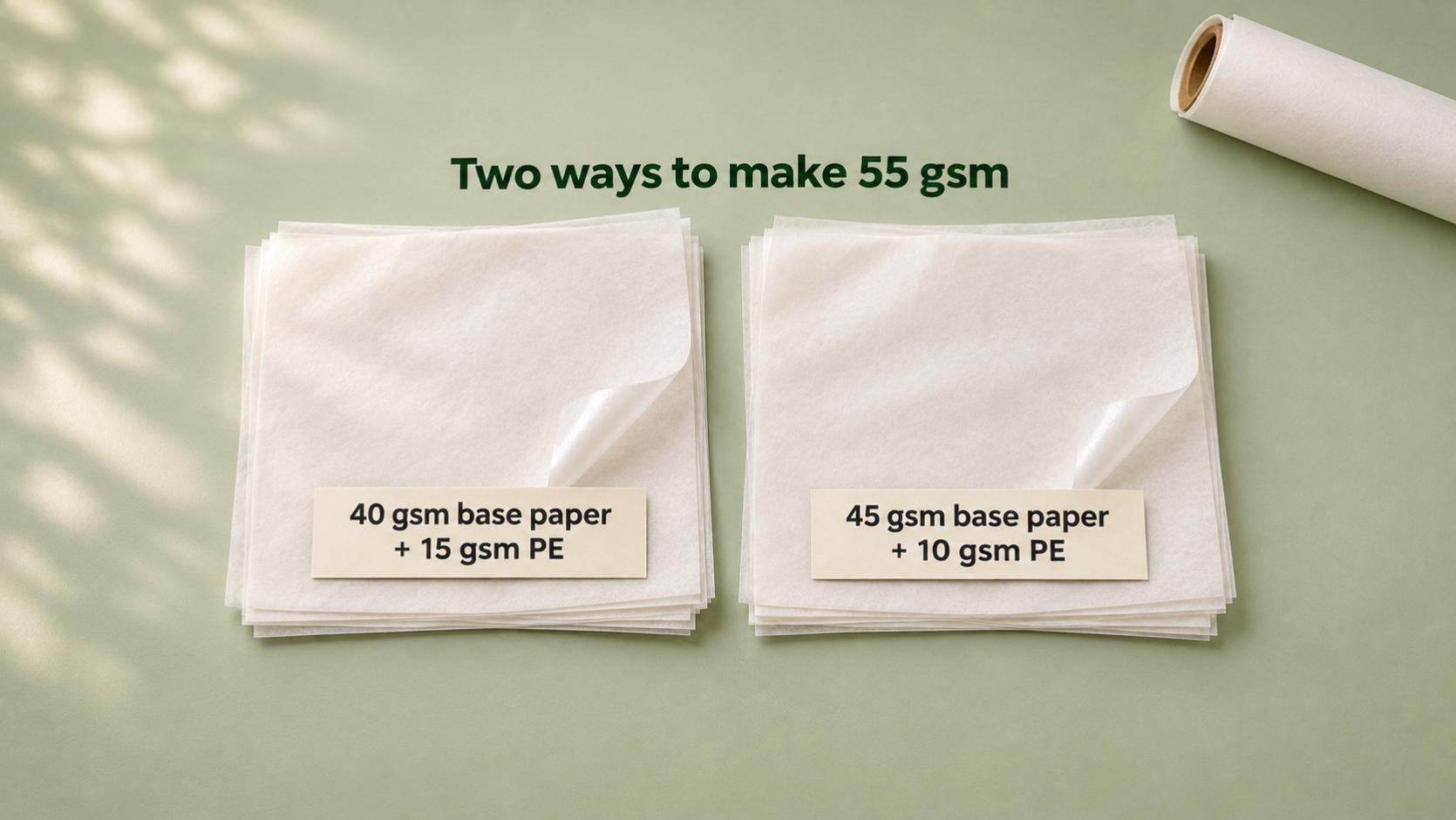
- Confirm base paper GSM and PE coating weight on each coated side.
- Check the intended PE print face for cleanliness and suitable treatment.
- Confirm ink suitability and the finished pack’s food-contact requirements.
- Agree adhesion and rub test methods, conditions and acceptance limits.
- Validate drying or curing, cooling, blocking and any heat-seal areas.
- Approve actual-stock print samples and complete the necessary machine trial.
FAQ
Which side of PE coated paper do you print on
For single-side coated stock, the paper face is usually the starting point, provided it is the intended outside face. Double-side coated stock requires a suitable PE print face. Confirm the finished wrap’s food-contact arrangement first.
Can you print on the PE coated side
Yes, with a compatible ink system and appropriate surface preparation. Check whether the supplied treatment remains suitable before printing and validate adhesion on the actual stock.
What dyne level is needed
Use the target specified for the actual ink, substrate and process. A dyne reading helps assess wetting, but does not replace an adhesion test or a production trial.
How should ink adhesion be checked
Use an agreed tape test after the specified drying or curing interval, record the test conditions and assess ink removal. Combine it with rub and handling tests appropriate to the end use.
Why do printed sheets stick together
Possible causes include insufficient drying or curing, retained heat and stack or winding pressure. Review the whole process and test samples under representative storage conditions.
Discuss Your Printing Requirements with Sure Paper
Send us your base paper GSM, PE coating weight, single- or double-side coating requirement, intended print face, printing method and food application. We can help confirm material options and sample availability for your evaluation.
Ask for A4 samples for an initial review and discuss sample-reel requirements for machine trials. Include the reel width or sheet size and order quantity if you also need a quotation per ton.
References
[1] EuPIA — Food contact materials and guidance on printing inks. https://www.eupia.org/key-topics/food-contact-materials/eupia-principles/
[2] Enercon — Improve Ink Printing Adhesion with Surface Treating. https://www.enerconind.com/web-treating/library-resource/improve-ink-printing-adhesion-with-surface-treating/
[3] ASTM D3359-23 — Standard Test Methods for Rating Adhesion by Tape Test. https://store.astm.org/d3359-23.html