Choosing a greaseproof paper supplier means checking whether the paper works for your food packaging and whether the supplier can deliver the agreed quality consistently. A competitive price per ton is only useful when specifications, compliance documents and delivery terms are clear.
Before placing a bulk order, review these eight areas. Start with the intended application, compare equivalent specifications and approve representative samples under realistic conditions.
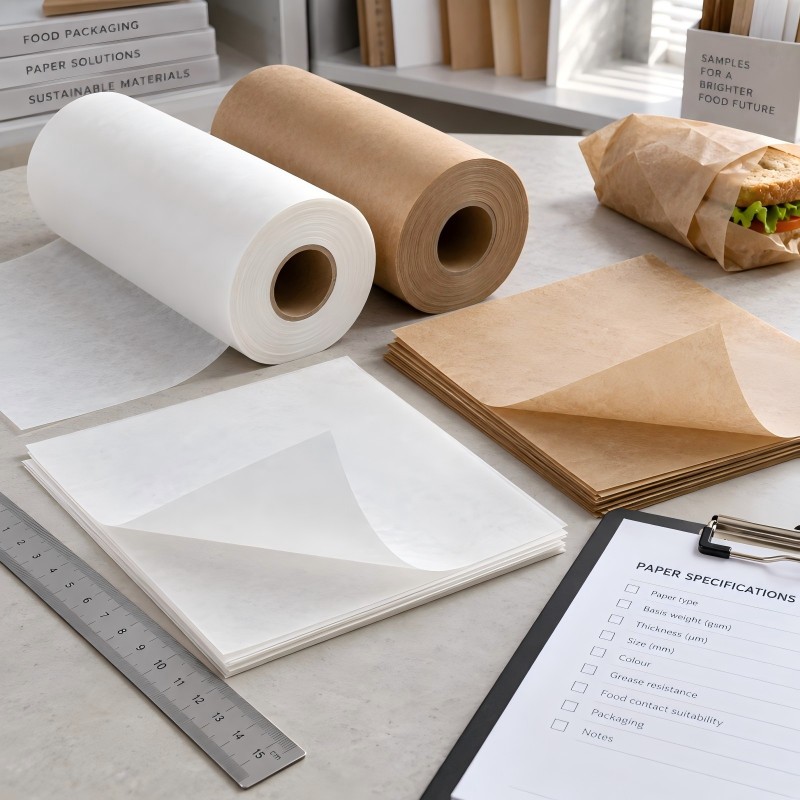
1 Check GSM and the Full Paper Specification
GSM means grams per square meter. It describes paper basis weight, but does not by itself establish strength, grease resistance or suitability for hot food. Select it together with the paper grade, required handling performance and converting process.
Give each supplier the same specification brief so that recommendations and quotations can be compared fairly.
| Item | Information to provide or confirm |
| Application | Burger wrapping, sandwich wrapping, bakery liners or fried-food tray liners. |
| Contact conditions | Food temperature, oil and moisture exposure, and expected contact time. |
| Paper and format | GSM, white or brown paper, sheets or rolls, dimensions and agreed tolerances. |
| Converting needs | Printing, folding, cutting or automatic wrapping; for rolls, core size, maximum diameter and splice requirements. |
| Order requirements | Quantity per specification, destination market and required delivery date. |
If you are replacing an existing paper, share its specification or a physical sample. Ask the supplier to explain any differences in the proposed alternative before approving it.
2 Verify Grease Resistance and the Test Method
A KIT rating can help describe grease repellency under defined laboratory conditions. A higher result generally indicates greater resistance in that test, but it does not guarantee longer protection with every food or packaging format.
TAPPI T 559 was developed primarily for fluorochemical-treated paper. Its suitability for nonfluorochemical treatments and film-like barriers needs to be evaluated. For PFAS-free grades, ask which method is appropriate for the paper and what additional performance evidence is available. [1]
This table is a broad purchasing reference, not a TAPPI application classification or a fixed food-selection standard. The suggested applications must be verified with the actual paper and food. Results from different barrier technologies should not be assumed to predict equivalent performance.
| KIT Level | General Grease Resistance | Potential Applications |
| KIT 1–4 | Lower | Relatively light grease exposure |
| KIT 5–8 | Moderate | General food wrapping and moderately greasy foods |
| KIT 9–12 | Higher | More demanding grease-contact applications |
Ask for the test method, tested side and sample condition. Then assess grease strike-through with your food at the intended temperature and contact time, including folded or creased areas. Oil resistance alone does not establish moisture resistance or oven suitability.
3 Confirm Food Contact Compliance for Your Market
Request documents that identify the supplied paper grade, its treatment or coating, and the intended food-contact conditions. A generic certificate or an unsupported “FDA approved” claim is not enough.
For the United States, ask the supplier to identify the applicable FDA regulatory basis for the paper and substances used. In January 2025, the FDA determined that 35 food contact notifications related to PFAS grease-proofing uses were no longer effective; a June 30, 2025 compliance date applied to certain existing products. Confirm the current basis for the grade you intend to buy. [2]
For the European Union, check the applicable food-contact framework, including Regulation (EC) No 1935/2004 and GMP requirements under Regulation (EC) No 2023/2006. Also confirm any destination-country requirements relevant to the paper and its intended use.
Under Regulation (EU) 2025/40, Article 5(5), food-contact packaging placed on the EU market from August 12, 2026 must meet the specified PFAS limits. A general “PFAS-free” statement should be supported by evidence relevant to these requirements. [3]
| Document or evidence | What to check |
| Compliance statement | Product identification, destination market, applicable requirements and intended food-contact conditions. |
| Supporting test reports | Sample identity, test date, conditions and relevance to the food, temperature and contact time. |
| PFAS information | Whether the claim means no intentional addition or a measured result; test scope, reporting limits and coverage of the finished product. |
| Lot inspection report or CoA | Results for agreed order specifications and identification of the supplied lot. |
| Traceability information | How the supplied batch can be linked to inspection and sourcing records. |
For printed paper, confirm that the documentation covers the relevant finished construction and intended food-contact side. Compliance documents and routine lot inspection records serve different purposes; do not assume every shipment receives a full set of laboratory compliance tests.
4 Review MOQ and Supply Reliability
Ask for the minimum quantity for your exact combination of GSM, size, color and printing. Confirm whether the MOQ applies per specification, per printed design or to the total order. A low headline MOQ may not apply to a custom requirement.
For repeat orders, ask how the supplier manages raw-paper availability, converting arrangements and peak-season demand. Confirm which activities the supplier handles and how quality is controlled across the supply chain.
Agree whether repeat orders must use the same approved paper grade and treatment. Any proposed change that could affect performance or compliance should be communicated and approved before shipment. Also ask how stock shortages or supply interruptions would be handled.
5 Compare Customization and Total Quoted Cost
Compare quotations using the same GSM, grease-resistance requirement, dimensions, quantity, printing and packing. Confirm which services are included and which charges are additional; a supplier does not need to disclose its internal cost breakdown for the quotation to be clear.
For custom printing, agree on the artwork, colors, printed side and approval process. Check setup or plate charges, whether they recur on repeat orders, and how custom packing affects the minimum quantity and lead time.
Keep trade terms separate from product charges. Confirm the Incoterm and named port or place, freight inclusion, payment terms, quotation validity and whether the quoted quantity is based on net paper weight. For sheets, also confirm sheet count and packing units so offers are comparable.
6 Check Quality Control and Complaint Handling
Ask what will be checked before shipment and which results you will receive. Depending on the order, routine checks may include GSM, dimensions, appearance, packing quantity and an agreed grease-resistance test. Moisture content, strength and other properties can be included where relevant to the application.
Define acceptance criteria before ordering. These should cover the tolerances and performance requirements that matter to your operation, rather than relying on a general promise of “high quality.” Ask how inspection records identify each batch and whether reference samples are retained.
Also agree on the procedure for a quality complaint: the reporting period, information required, who investigates and how a confirmed issue will be resolved. Photos, batch labels, affected quantities and retained samples can help the supplier identify the cause. Clear responsibility matters as much as the inspection checklist.
7 Confirm Lead Times and Delivery Milestones
Ask when the delivery clock starts: deposit receipt, artwork approval or final sample approval. Confirm when the goods will be ready for shipment and distinguish that date from the estimated arrival date.
For a custom order, request milestones for specification approval, production or converting, inspection and packing. Check whether these activities overlap before adding their durations together. Freight transit and customs clearance should be considered separately.
Ask how delays will be communicated and what happens if the planned shipping date changes. For repeat or seasonal purchases, discuss forecasts and order timing early rather than assuming capacity will always be available.
8 Test Representative Samples Before a Bulk Order
Use sample testing to check the proposed grade with your actual food and packing process. Initial material evaluation can use representative paper samples. Final approval for a customized product should cover the relevant finished dimensions, printing, treatment and food-contact side.
Compare suppliers under the same conditions. Record the food used, temperature, contact time and wrapping method, then inspect for grease strike-through, moisture penetration, tearing and handling problems. Include folds and creases when these are part of normal use.
Keep an approved reference sample and record its specification. Agree how bulk deliveries will be checked against that reference. Passing a sample test is an important purchasing step, but it does not replace inspection of the production order.
Frequently Asked Questions
Does higher GSM mean better grease resistance
No. GSM measures basis weight. Grease resistance depends on the paper structure and barrier treatment as well as the conditions of use. Compare performance evidence alongside GSM.
Does a higher KIT rating mean the paper is PFAS free
No. KIT evaluates performance under a particular test; it does not establish chemical composition or regulatory compliance. Request separate PFAS information and relevant supporting evidence.
Can food wrapping greaseproof paper be used for baking
Do not assume so. Ask for a grade specifically suitable for the intended oven temperature and duration, supported by the relevant product information. A grease-resistance rating alone does not demonstrate baking suitability.
What should I include in a quotation request
Provide the food application, destination market, GSM or current paper specification, sheet or roll dimensions, printing requirements and quantity per specification. Include required delivery timing and your preferred shipping terms.
Discuss Your Greaseproof Paper Requirements
Looking for greaseproof paper for your packaging business? Send Sure Paper your application, specifications, printing requirements, order quantity and destination market. We can review the requirements with you and discuss suitable options, sample arrangements and a quotation.