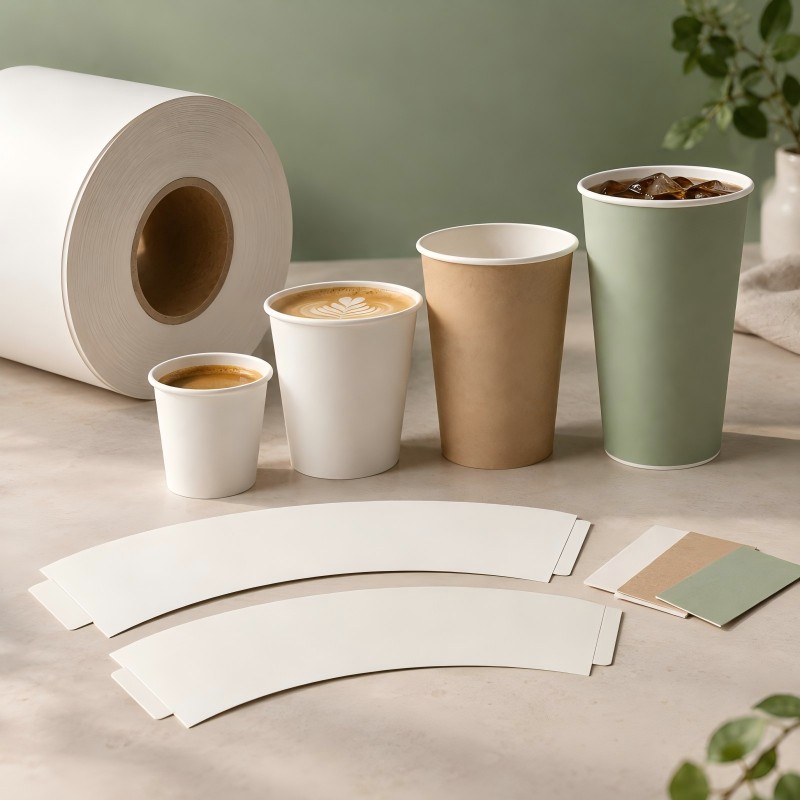
Choosing cupstock starts with cup capacity, but the final specification also depends on cup dimensions, paperboard stiffness, wall structure, coating and forming performance. For buyers, the aim is to find a material that makes a reliable cup without adding unnecessary weight or cost.
Use capacity-based GSM ranges to shortlist materials, then confirm the exact paper grade and coating structure through sample evaluation and cup production trials. Always distinguish base paper GSM from the total grammage of coated cupstock.
Key Takeaways
- Cup capacity is a starting point, not a complete material specification.
- The GSM ranges below refer to cup-body base paper, excluding coating. Cup-bottom and outer-wall materials require separate specifications.
- Compare thickness, stiffness and coating as well as GSM, and verify performance on the intended cup machine.
Cupstock GSM Reference by Cup Size
The broad ranges below are indicative starting points for discussing cup-body materials with a supplier. They are not an industry standard or a guarantee of suitability for every cup within each capacity group.
| Cup size | Capacity | Indicative base paper GSM Excluding coating |
| Small | 4–8 oz | 170–210 gsm |
| Medium | 9–16 oz | 210–280 gsm |
| Large | 18–32 oz | 250–320 gsm |
These ranges do not specify cup-bottom paper or the outer layer of a double-wall cup. Suitable grades may fall outside them. Confirm the cup dimensions, paper grade, coating and trial results before placing an order.
Larger cups generally need more structural support, but selecting the upper end of a range is not automatically the best solution. A broad group such as 9–16 oz includes several cup designs that should be assessed individually.
What Changes the GSM You Need
Cup dimensions and shape
Two cups with the same stated capacity can have different rim diameters, bottom diameters and heights. These differences affect the cup design and material requirements. Send the supplier a drawing or provide all three dimensions, together with the nominal capacity and intended fill level.
Paper thickness and stiffness
GSM measures weight per square metre; it does not directly measure thickness or stiffness. Two grades with similar GSM can perform differently. Request the technical data sheet and compare thickness and machine-direction and cross-direction stiffness using the same test method and conditions wherever possible.
When trying a lower GSM, evaluate the actual candidate grade instead of assuming that all papers at that weight will behave alike. The finished cup must still meet handling and use requirements.
Single-wall and double-wall construction
A single-wall cup relies on its cup-body board and barrier layer. A double-wall cup adds a separate outer structure for insulation and rigidity. Specify the inner cup and outer layer independently; adding their GSM values together does not create a meaningful comparison with single-wall cupstock.
Do not assume that adding an outer layer automatically allows a lighter inner cup. The inner cup still needs to form, seal and hold the beverage reliably.
Hot drinks and cold drinks
For hot drinks, evaluate the paper and coating together at the intended filling temperature and holding time. For cold drinks, consider external condensation as well as contact with the beverage inside. The appropriate barrier structure depends on these conditions, so increasing GSM alone should not be treated as a solution to moisture exposure.
Handling and forming requirements
Consider how the cup will be filled, carried and handled, and how long it will remain in use. Confirm that the proposed material suits the forming equipment and intended production speed. If the cup feels too soft or forms poorly, review the paper grade, cup structure, coating and machine settings before simply increasing GSM.
Base Paper GSM and Finished Cupstock Weight
GSM means grams per square metre. Base paper GSM describes the paperboard before the specified barrier coating is added. Finished cupstock grammage includes the base paper and the coating layers. A quotation stating only “250 gsm” is incomplete unless the supplier explains which weight it represents.
How to calculate coated cupstock grammage
For a simple PE-coated structure, theoretical total grammage equals base paper GSM plus the coating weight on each side.
| Example structure | Base paper | Inside PE | Outside PE | Theoretical total |
| Single PE | 250 gsm | 18 gsm | — | 268 gsm |
| Double PE | 250 gsm | 18 gsm | 15 gsm | 283 gsm |
These examples illustrate the calculation only; they are not coating recommendations for a particular cup size. Actual supplied grammage is subject to the agreed tolerances. For other barrier systems, ask the supplier to state the dry coating weight and any additional layers.
What to confirm in a quotation
- The exact paper grade and base paper GSM.
- The coating type and weight on the food-contact side and the outside.
- The total finished grammage and agreed tolerances.
- Whether the price and ordered tonnage refer to uncoated paper or finished coated material.
Keep these items separate on the specification sheet. This makes quotations easier to compare and helps prevent confusion between, for example, 250 gsm base paper plus PE and 250 gsm total coated cupstock.
Test Samples Before a Bulk Order
Use the candidate material to produce trial cups on the intended equipment. Check side-seam and bottom sealing, rim formation and visible defects. Then fill the cups with the intended beverage, or an agreed test liquid, at the expected temperature and assess leakage, shape retention and handling over the required holding time.
Agree the test conditions and acceptance criteria before evaluation. Retain approved samples and record the paper grade, coating structure and trial settings so the bulk order can be matched to the approved specification.
Get Help Selecting Cupstock for Your Cup
Sure Paper can help you review cupstock options and arrange suitable samples for evaluation. To discuss a specification or request a quotation, share:
- Cup capacity, rim diameter, bottom diameter and height, or a cup drawing.
- Hot or cold beverage use, expected filling temperature and holding time.
- Single-wall or double-wall construction.
- Your current paper grade, base GSM and coating specification, if available.
- Required supply format: reels, sheets or cup fans, with dimensions.
- Order quantity and destination port.
Contact Sure Paper with your cup design and requirements to discuss candidate materials, sample arrangements and a quotation.
Frequently Asked Questions
Is higher GSM always better for paper cups
No. Higher GSM increases material weight, but cup performance also depends on paperboard properties, coating, structure and forming quality. Choose a specification that passes the agreed performance checks without unnecessary material consumption.
What GSM should I use for a 12 oz paper cup
The 210–280 gsm base-paper range in the table can be used as an initial discussion range, excluding coating. It is not a confirmed specification for every 12 oz cup. Provide the cup dimensions, wall structure and beverage conditions, then evaluate a suitable grade through trials.
Can the same GSM be used for different cup sizes
Sometimes, provided the selected grade meets the requirements of each design. Each cup size should be evaluated separately; successful use in one cup does not establish suitability for another.
Should cup-bottom paper have the same GSM as the cup body
Not necessarily. Specify the bottom paper separately and confirm its compatibility with the cup-body material, coating structure and bottom-sealing process through trials.
How can I compare quotations from different suppliers
Compare the base grade and GSM, coating type and weight on each side, total grammage, tolerances and supply format. Review technical data and samples as well as price, so the comparison reflects the material you will actually receive.