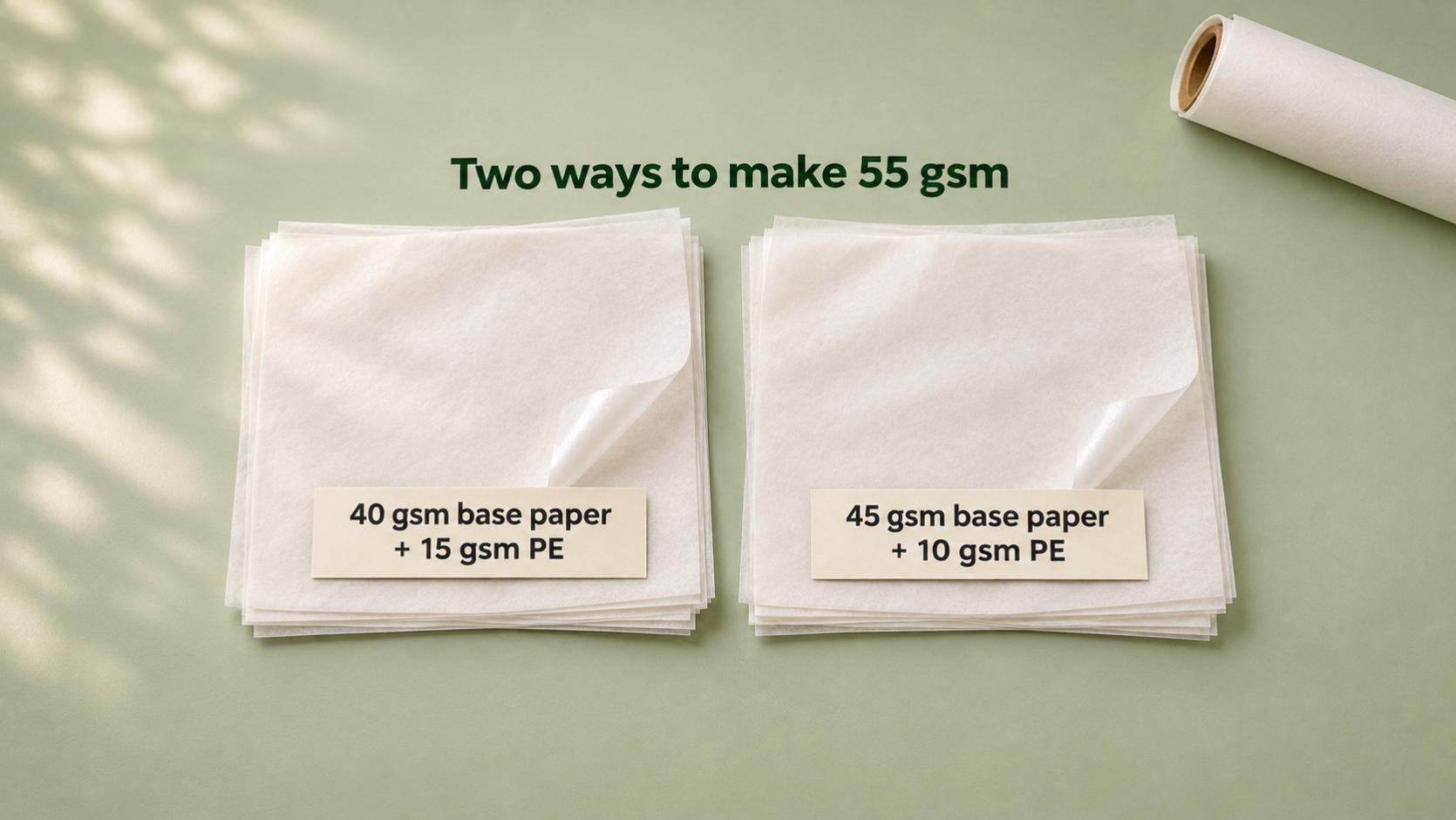
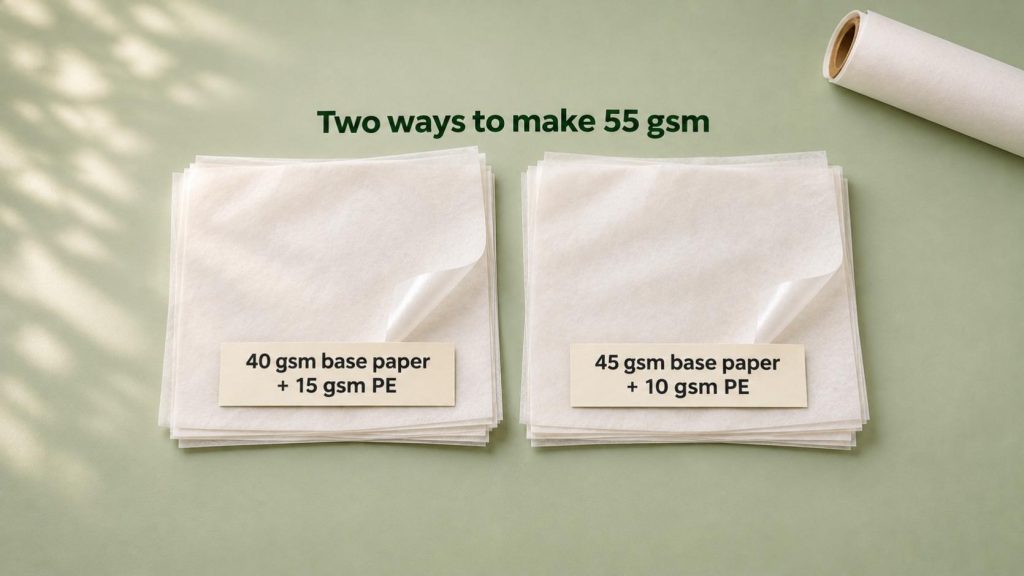
An enquiry for “55 gsm PE-coated wrapping paper” leaves an important question open: is 55 gsm the weight of the base paper or of the finished sheet? Even if both suppliers quote a 55 gsm finished sheet, one may offer 40 gsm paper with 15 gsm of polyethylene (PE), and the other 45 gsm paper with 10 gsm of PE. Both add up correctly, but they are different products.
Specify the paper grade and weight first, then the PE coating weight on each face. Use the finished weight to check the arithmetic and estimate how much wrapping area you will get per metric ton.
How to read a paper and PE specification
Grammage is mass per unit area, expressed in grams per square metre (g/m²), often written as gsm. Base paper grammage describes the paper before coating. PE coating weight describes how much polyethylene is applied per square metre on a specified face.
For a sheet made only of paper and PE, the nominal finished grammage is the base paper grammage plus the PE on both faces. Count an uncoated face as zero. “Nominal” means the specified target; agree on acceptable production tolerances separately.
| Example structure | Base paper | Food-side PE | Reverse-side PE | Finished total |
| Single-sided | 40 gsm | 15 gsm | Uncoated | 55 gsm |
| Single-sided | 40 gsm | 20 gsm | Uncoated | 60 gsm |
| Double-sided | 40 gsm | 10 gsm | 10 gsm | 60 gsm |
The last two examples contain the same total amount of PE. The difference is where the PE sits: one leaves a paper surface exposed, while the other presents PE on both sides. A double-sided coating can also have different weights on each face. Give both values instead of writing “20 gsm PE, double-sided.”
Choose the base paper and coating for the wrap
Start with the grade you use or want to trial, such as white machine-glazed (MG) paper or brown MG kraft. Base weight influences handling, but two papers of the same weight can feel different. For a folded sandwich wrap, check whether the sheet folds neatly around the food, holds its shape and feeds through your equipment without tearing.
For the coating, tell the supplier what will touch the paper, at what temperature and for how long. If a sauce reaches a corner of the wrap, test that fold as well as the flat sheet. For a heat-sealed pack, identify which surfaces meet and trial them at your actual temperature, pressure and dwell time. Coating weight alone cannot establish food-contact suitability or seal strength.
Calculate wrapping area per metric ton
Use the finished grammage for the yield calculation. One metric ton equals 1,000,000 g. Dividing that mass by the grams in one square metre gives the theoretical area of finished material.
40 gsm paper + 15 gsm PE = 55 gsm finished
1,000,000 g ÷ 55 g/m² ≈ 18,182 m² per metric ton
Dividing by 40 instead would give 25,000 m², which overstates the area because it leaves out the coating. The 18,182 m² figure assumes nominal grammage and one metric ton of finished material; usable output will be lower once you allow for trim and converting waste.
An RFQ you can copy
For a single-sided wrap, identify the coated face by its intended use. If the outside will be printed, say so. For double-sided paper, replace “reverse side uncoated” with the target PE weight for that side.
Please quote white MG sandwich wrapping paper in reels: 40 gsm base paper with 15 gsm PE on the food-contact side. The reverse side is uncoated and will be printed. Nominal finished grammage: 55 gsm. Reel width: ___ mm. Order quantity: ___ metric tons. Please quote per metric ton.
For sheet orders, replace reel width with sheet length and width. If winding direction matters on your line, specify whether the coated face should be wound in or out.
What to verify before placing the order
On the quotation: Match the base grade, base weight and PE weight on each face to your enquiry. If a supplier proposes 45 + 10 instead of 40 + 15, treat it as an alternative for trial, even though the total is unchanged.
On an A4 sample: Check the designated faces, surface finish and fold feel. Weighing a sample of known area can check finished grammage; it cannot tell you how the weight is split between paper and PE. Confirm the layer targets against the product specification and request coating-weight records if you need to verify a batch.
On a trial reel: Check feeding and print adhesion, then fold or seal the wrap as you would in production. Test the finished pack with the intended food for the expected holding time. Agree on weight tolerances and retain the approved specification for repeat orders.
To request samples or a quotation from Sure Paper, send your application, base paper grade and gsm, PE weight per side, dimensions and quantity. If you only know the finished gsm, tell us how the wrap will be used so we can suggest a structure to trial.