Short answer: greaseproof paper may be recyclable, biodegradable or compostable, but these outcomes are not guaranteed simply because the product is paper-based. The answer depends on how the grease resistance is achieved, whether the paper contains coatings or additives, how heavily it is contaminated after use, and which collection and processing facilities are available locally.
For buyers and packaging converters, the most reliable approach is to evaluate the finished product—not just the base paper—and request evidence that supports any environmental claim.
Quick Answer
| Question | Practical answer | Main condition |
|---|---|---|
| Recyclable? | Sometimes | The material must be compatible with the local paper-recycling process and usually clean enough for fiber recovery. |
| Biodegradable? | Potentially | Cellulose can biodegrade under suitable conditions, but coatings, inks and additives can change the result. |
| Compostable? | Only with evidence | The finished item should be tested or certified for the stated home- or industrial-composting environment. |
First, Identify What Type of Paper You Are Using
The term “greaseproof paper” is often used broadly in the food-packaging market, but different papers obtain their barrier performance in different ways. That difference strongly affects end-of-life options.
| Paper type | How performance is achieved | Typical consideration |
| Traditional uncoated greaseproof paper | A dense fiber structure created through intensive refining | May be more compatible with fiber recovery when clean and accepted locally. |
| Silicone-coated baking paper | A silicone release coating provides non-stick performance | Recycling and composting depend on the complete construction and local process. |
| Waxed paper | A wax layer provides grease and moisture resistance | Many conventional paper streams do not accept it. |
| Polymer-barrier paper | PE, PLA or another polymer/water-based barrier is applied | Repulpability or compostability must be evaluated for the specific finished product. |
A PFAS-free declaration addresses the absence of intentionally added PFAS; it does not, by itself, prove that a paper is recyclable, biodegradable or compostable.
Is Greaseproof Paper Recyclable?
Greaseproof paper may be recyclable when its fibers can be recovered efficiently and the complete material is accepted by the relevant recycling system. Clean, dry, uncoated greaseproof paper generally has a better chance of acceptance than heavily food-soiled or multilayer material, but local rules remain decisive.
How Coatings and Treatments Affect Fiber Recovery
Paper recycling begins by mixing recovered paper with water so the fibers separate into pulp. Coatings, waxes, wet-strength additives and polymer layers can reduce fiber yield, remain as residue or require a recycling process that is not available at every mill.
This does not mean every coated paper is automatically non-recyclable. Buyers should ask for repulpability or recyclability testing that reflects the exact paper, coating weight, printing and finished construction.
How Food Contamination Affects Recycling
Food residue, oil and grease can contaminate recovered fibers. Many collection programs therefore require paper to be clean and dry.
| Condition after use | Likely outcome |
| Clean, dry and uncoated | May be accepted where local paper-recycling rules allow. |
| Lightly soiled | Acceptance varies by collection program and mill. |
| Heavily grease-soaked or covered with food | Often unsuitable for conventional paper recycling. |
| Coated, waxed or laminated | Depends on the material construction and available processing technology. |
Is Greaseproof Paper Biodegradable?
Biodegradable means that microorganisms can break a material down under particular environmental conditions. The term alone does not tell you how quickly degradation occurs or whether it will happen in landfill, soil, marine environments, home compost or an industrial composting facility.
Cellulose fibers can biodegrade under suitable conditions. However, the behavior of a finished greaseproof paper also depends on coatings, additives, inks and adhesives. A paper-based product should therefore not be marketed as biodegradable solely because it contains natural fibers.
Biodegradable vs. Compostable
Biodegradable is a broad description of material breakdown. Compostable is a more specific claim tied to defined conditions, time frames, disintegration, biodegradation and the quality of the resulting compost. A material can be biodegradable without being certified compostable.
Is Greaseproof Paper Compostable?
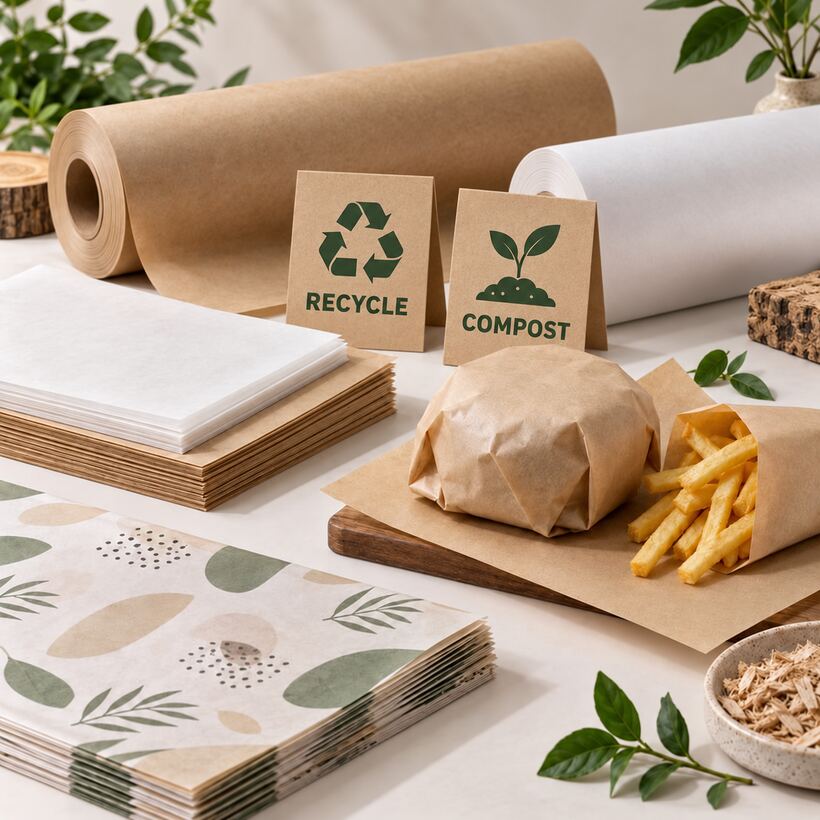
Some greaseproof papers can be compostable, but the claim should cover the complete finished item. That includes the base paper, grease-resistant treatment, coating, ink, adhesive and any other component used in the packaging.
Home Composting vs. Industrial Composting
Home composting operates at lower and less controlled temperatures. Industrial composting facilities can maintain more controlled temperature, moisture and oxygen conditions. A product certified for industrial composting is not automatically suitable for home composting.
- Confirm whether the certificate applies to the complete finished product.
- Check whether the claim covers home composting or industrial composting.
- Verify that the intended market has a facility that accepts the item.
- Confirm that printing inks, adhesives and additional converting materials are included in the assessment.
Which Compostability Standards Are Relevant?
The relevant standard depends on the product construction and sales market:
- ASTM D6400 primarily covers plastics and products made from plastics that are intended for aerobic municipal or industrial composting.
- ASTM D6868 is generally more relevant to paper and other substrates that incorporate plastic or polymer coatings, binders or additives and are intended for aerobic municipal or industrial composting.
- EN 13432 specifies requirements for packaging recoverable through industrial composting and biodegradation in the European market.
Referencing a standard is not the same as holding a valid certificate. Buyers should check the certificate holder, product name, scope, test basis and validity, and confirm that the document covers the product being purchased.
What B2B Buyers Should Verify
Before choosing greaseproof paper for food wrapping, tray liners, bakery products or custom-printed packaging, ask the supplier to confirm:
- Product construction: uncoated, silicone-coated, waxed or polymer-barrier paper.
- Base fiber and sourcing information, including FSC or PEFC availability where required.
- Grammage, grease resistance or KIT level, wet strength and converting performance.
- PFAS-free documentation and applicable food-contact compliance documents.
- Whether environmental claims apply to the base paper or the complete converted item.
- Available recyclability, repulpability, biodegradation or compostability reports.
- Compatibility of inks, adhesives and coatings with the intended disposal claim.
- Acceptance rules and labeling requirements in the destination market.
These checks help buyers avoid vague “eco-friendly” claims and select a material that matches both packaging performance and the intended waste-management route.
How Should You Dispose of Greaseproof Paper?
There is no universal disposal route. Use the following order of checks:
- Read the product label and supplier documentation.
- Identify whether the paper is coated, waxed, laminated or uncoated.
- Check how much food or grease remains on the paper.
- Look for a valid certificate covering the intended disposal environment.
- Follow the instructions of the local recycling or composting operator.
- Use general waste when no suitable collection or processing route is available.
FAQ
Can clean greaseproof paper go in the recycling bin?
Possibly. Clean and dry uncoated greaseproof paper may be accepted, but coated paper and local collection rules vary. Check with the local recycling provider.
Does silicone coating make greaseproof paper non-recyclable?
Not in every recycling system, but silicone can affect pulping and acceptance. Evaluate the specific coated paper and the capabilities of the receiving mill.
Can greasy greaseproof paper be recycled?
Often not through conventional paper recycling. Heavy oil and food contamination can reduce fiber quality and contaminate the recovered-paper stream.
Can I compost greaseproof paper at home?
Only when the complete product is suitable for home composting. Industrial-compostability certification does not automatically support a home-composting claim.
Does PFAS-free mean compostable?
No. PFAS-free, recyclable, biodegradable and compostable are separate claims and require different evidence.
What documents should a buyer request?
Depending on the claim, request the product specification, food-contact documents, PFAS-free declaration, fiber certification and any relevant test report or compostability certificate for the finished product.
Choose the Paper Based on Its Complete Construction
Greaseproof paper is not automatically recyclable or compostable simply because it is made from paper. Its end-of-life outcome depends on the fiber composition, barrier technology, converting materials, food contamination and available local infrastructure.
Sure Paper supplies white and brown greaseproof paper for food wrapping, tray liners and custom-printed packaging in different grammages, KIT levels, reel widths and sheet sizes. Contact us to discuss your application, converting requirements and required compliance documents.